
Hey, small business owner...
You click the link. You enter your password. You approve the MFA push on your phone. Everything looks completely normal.
You go back to work feeling safe.
What you don't realize is that at that exact second, a criminal just hijacked your entire session and is now sitting inside your Microsoft 365 account, your banking portal, or your client files - completely undetected.
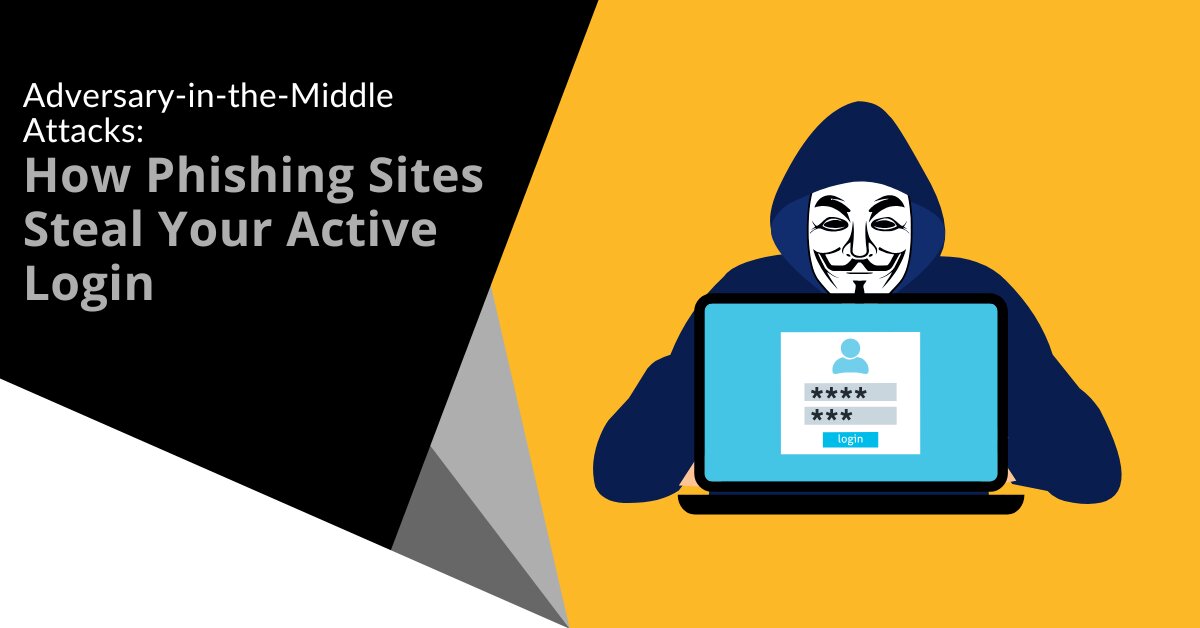
This isn't old-school phishing. This is Adversary-in-the-Middle (AiTM) - one of the most dangerous and fastest-growing threats hitting businesses right now.
And if you think your MFA protects you... you're in for a nasty surprise.
In this article, we're exposing exactly how AiTM attacks work, why they're beating traditional MFA, and what you can do right now to fight back before it's too late.
Phishing Has Moved Beyond Passwords
Phishing didn't die. It evolved - and got much smarter.
Criminals no longer just want your password. They want something far more valuable: your already-authenticated session.
Traditional phishing stole credentials. Modern AiTM attacks silently steal the active login session while you're logging in. That means even with MFA enabled, attackers can walk right past it like it's not even there.
How AiTM Attacks Actually Work
The fake login page that isn't fake
The attacker doesn't build a cheap copy of your login page. They create a live reverse proxy that sits between you and the real Microsoft or Google server.
Every keystroke, every click, every MFA approval flows through the attacker's system in real time. From your side, everything feels completely normal - correct branding, working redirects, real MFA prompt.
You log in successfully. The attacker quietly steals your session cookie. Game over.
Why MFA doesn't stop it
MFA only protects the login moment. Once you complete it, the system issues a session token that says "this user is trusted."
AiTM attacks wait for that trusted token, then steal it. The attacker doesn't need your password or MFA code anymore - they just replay your active session.
Microsoft has reported a massive 146% increase in these attacks. Phishing-as-a-Service tools like Evilginx make it frighteningly easy for even low-level criminals to run them at scale.
Session cookies
Once the attacker has your session cookie, they import it into their own browser and pick up right where you left off - inside a fully trusted, already-verified account. No alerts. No red flags.
What Happens After a Session Is Stolen
This is where it gets scary.
The attacker now operates inside your real account. They can create hidden inbox rules, add new MFA methods to lock you out, steal client data, or use your trusted account to attack your own team.
Many businesses don't discover the breach until money is gone or sensitive data has been leaked.
Reducing Your Exposure
Adopt phishing-resistant MFA
Switch to FIDO2 hardware keys or passkeys. These bind authentication to your specific device and the real website. AiTM proxies can't relay them.
Tighten Conditional Access policies
Use location-based rules, device compliance checks, and risk-based sign-ins to spot suspicious activity after login.
Train users on URL awareness
Teach your team to always check the actual URL - even if the login page and MFA prompt look perfect.
For small businesses in Middlesex County, Parsippany, and Manhattan handling client data every day, these extra layers of protection are no longer optional - they're essential.
Stop Protecting Just the Login Screen
MFA is no longer enough by itself.
The smartest small businesses are moving beyond basic MFA to full session protection and identity security layers.
You don't need a massive security team. You need the right strategy.
Ready to plug this dangerous gap before attackers do it for you?
Network Six has teams right here in Parsippany, Middlesex, and Manhattan helping local small businesses strengthen their identity security and stop AiTM attacks in their tracks.
Contact Network Six today for a no-pressure Identity Security Assessment. We'll review your current setup, show you exactly where you're vulnerable to AiTM attacks, and give you a clear, actionable plan to lock it down fast.
Because hoping your MFA is enough is no longer a strategy in 2026.
Protect what you've built.
Your move.
Article FAQs
What is an Adversary-in-the-Middle (AiTM) attack?
An AiTM attack is a sophisticated phishing technique where attackers use a proxy to intercept and steal active login sessions in real time, even after MFA is completed.
Can AiTM attacks bypass MFA?
Yes - not by breaking MFA, but by stealing the authenticated session token right after you successfully log in.
How can businesses reduce the risk of AiTM attacks?
Using phishing-resistant MFA (like passkeys), tightening Conditional Access policies, training employees to check URLs, and monitoring for suspicious post-login activity.
Article adapted and optimized with current 2026 insights, used with permission from The Technology Press.